HOW “THE ARMY OF TWO” – THE BATES SISTERS – SAVED SCITUATE HARBOR, MASSACHUSETTS, U.S.A. DURING THE WAR OF 1812
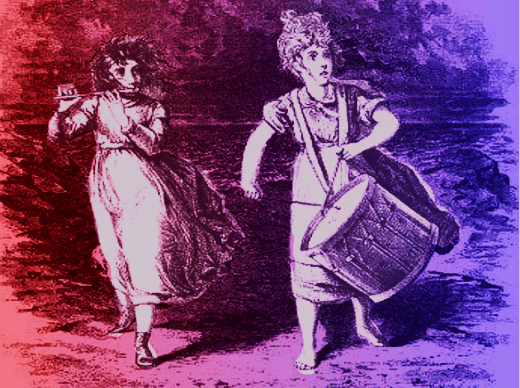
Rebecca Bates (left) and Abigail Bates (right) playing fife and drum. (illustration: New England Historical Society)
“All warfare is based on deception. Hence, when we are able to attack, we must seem unable; when using our forces, we must appear inactive; when we are near, we must make the enemy believe we are far away; when far away, we must make him believe we are near.”
― Sun Tzu, The Art of War
***
A CLEVER RUSE AND DARING DO
Two American sisters, Rachel and Abigail Bates, concocted a clever ruse which prevented a raiding party from a Royal Navy frigate H.M.S. La Hogue from landing ashore at the village Scituate Harbor, Massachusetts during the War of 1812. Their imagination and daring do demonstrate the power of deception in warfare; their story demonstrates the validity of Sun Tzu’s timeless message: “All warfare is based on deception.”
***
CAPTAIN SIR THOMAS BLADEN CAPEL AND HIS FLAG SHIP:
THE ROYAL NAVY FRIGATE H.M.S. LA HOGUE

H.M.S. La Hogue, a 74-gun frigate, third-rate ship of the line of the Royal Navy, was built and launched in 1811 at Depford, England. (painter: William Clark: painting: Glasgow Life Museums)
***
Captain Sir Thomas Bladen Capel served as one of the Royal Navy’s star frigate captains. He was the youngest son of William, fourth Earl of Essex, and a favorite of Admiral Horatio Nelson. He had distinguished himself during the French Revolutionary War and the Napoleonic Wars.
During the Battle of Trafalgar in 1805, Captain Capel commanded the British frigate, H.M.S. Phoebe, and his mission was to repeat signals and stand ready by to assist any vessel in the Fleet; his warship took no part in the fighting. During the gale that followed the battle, ‘by extraordinary exertions’ Captain Capel’s Phoebe helped save the French prize Swiftsure (not to be confused with the British ship bearing the identical name) from destruction.
Upon its launch, Captain Capel, then thirty-five years old, was appointed master and commander of new frigate H.M.S. La Hogue in 1811. The ship was a 74-gun frigate that carried a crew of approximately 470 able-bodied seamen also commonly called “Jack Tars” or “Tars.”.
Trafalgar Captains Trafalgar Captains | The 1805 Club
***
H.M.S. LA HOGUE ORDERED INTO AMERICAN WATERS
The victory of the U.S.S. Constitution over H.M.S. Guerriere in a fierce sea battle off of Halifax Nova Scotia, Canada, the previous year had stunned the British Admiralty in London, and it prompted the First Naval Lord to send reinforcements.
On January 9, 1813, Captain Capel and his 74-gun flagship La Hogue, along a squadron of Royal Navy frigates under his command, sailed for North America; they patrolled and largely controlled and dominated the Northeastern coastal waters of the United States for the remainder of the War of 1812.
The Ipswich Journal (Ipswich, England) reported:
“At length it is determined to increase the naval force on the Halifax station, with ships large enough to cope with the American frigates. Orders, it is said, have been given for an examination of several 74’s, for the purpose of selecting such as may be reduced to 64-gun ships…
“The complement of an English 74 is 500 men, but seldom is there on board, even in the home stations, more than from 460 to 480, and of these, generally about 30 are foreigners, and about 60 are boys. The United States, in the recent engagement, had a complement of 478 men; that is 12 less than the nominal complement of our 74’s, and at least equal to the number that any 74 actually has on board. But a consideration of by far greater consequence than the quantity of men, is their quality. From the extended state of the British navy, it is impracticable to man our fleets with seamen. About 6-7ths of every ship’s company are landmen; and thus in a 74, there are seldom more than 70 hands that can be put upon the forecastle or rated able.
“Now the Americans, having but few national vessels, are able to man their ships, not only entirely with sailors, but with picked choice sailors; and they have been but too successful in enticing some of our ablest hands to become their petty officers. It must not, however, be imagined that, with equal force, we could effect our conquests over the Americans so easily as we have been accustomed to effect them over the French. At the beginning of last war, our naval triumphs were often precarious, and always dearly purchased. It was not until the seamen of the continent, by being so long blockaded in their ports, had been disused to their element, that our victories were achieved with so much facility. It is now far otherwise with the American seamen, they have been long in the habit of cruizing and practising naval evolutions and tactics, and nearly one half of their crews are British sailors, and, what is of nearly as much consequence, the other half have been bred up and formed in the British navy…”
Wednesday’s Post, Ipswich Journal, Ipswich England, 09 Jan 1813, p. 4
***
H.M.S. LA HOGUE CROSSES THE ATLANTIC OCEAN
Details from the H.M.S. La Hogue’s Ship’s Log present the frigate’s close to six-week passage across the Atlantic Ocean from Portsmouth England to Halifax, Nova Scotia:
In early January 1813 La Hogue was lying in port at Portsmouth. On the 5th, she made preparations for the Atlantic crossing and started to take on Stores which included:
“Tobacco – 1225 pounds
Bread – 28,000 pounds in bags
Wine – 1386 Gallons
Rum – 1275 gallons
Lemon Juice – 3528 gallons
Butter – 3300 pounds
and, the day before sailing, 13th January,
Water – 222 tons”
“During this time, while the ship was being outfitted: sailors were making new hammock cloths, crew were variously employed about the rigging; top gallant masts were fitted; and, previously, the artificers had been careening the ship in order to repair the copper-lined hull.
“14th January. Set Sail from Spithead.
15th January. Squadron, H.M.S. Valiant and H.M.S. Prevoyant, in company.
16th January. Eddystone Lighthouse.
17th January. The Lizard (Cornwall, England). Lat.49.40. Long. 5.43.”
“Details of the ship’s course, changes in weather conditions, and setting of the sails were recorded in the Log:
“19th January. Fresh breezes and squally. Set the jib. 4th Dog Watch.
Squadron in company. 6.30. Out third reef of topsails.
Set fore and main top gallant sails, main top staysail.
7.35. A stranger on the bow. 8th Dog Watch. Set top gallant stud sails. 8.10. Carried away main top gallant stud boom. 10.15. Out second reef of fore and mizzen topsails. Set staysails, top and top gallant stud sails and spanker.”
“Many other ship’s activities were entered in the Log:
“24th January. Mustered ships company and read The Actions of War (more commonly called The Articles of War).
28th January. Calm and cloudy weather. Distance run 34 miles.
31st January. Strong gales, squally. Distance run 206 miles.
2nd February. 8.10. Carried away starboard foretop studsail boom.
9.30. Carried away the jib tacks. Down jib.
11.00. Observed Valiant carry away her fore topmast and fire gun with blue light.
11.30. Got new foretop studsail boom up.
12.03. Lowered a boat to pick up a spar.
6th February. Waiting for Prevoyant to come up.
8th February. Punished with Cat ‘O Nine Tails: Jas Barratt, 24 lashes for striking a sergeant, John McNabb, 24 for insolence, Thos Flyn, 24 for striking a man, Charles Clark, 24 for disobeying orders.
11th February. Sailmakers making windsails out of canvas drawn for making maindeck awning, the studsail lost overboard. Carpenters making studsail yards. Armourer in the forge.
17th February. Lowered boat to try current. Found it set N. by W.
24th February. Arrived Bermuda, furled sails, moored ship.”
“The voyage of some 3000 miles had taken one day short of six weeks.
“After taking on fresh food and water at Bermuda, La Hogue set sail across the shipping lanes to Halifax, Nova Scotia, in company with three other ships. An amusing entry in the Log during this stay read ‘8th March. Found missing Instructor Emmanuel, supposed to have lowered himself and swum ashore.’ Two days out it was noted ‘People employed washing their clothes’ and four days out ‘Main staysail split. Hauled down to repair.’
“The Royal Navy squadron then entered the shipping lanes. On 17th March a strange Brig was sighted and Valiant gave chase. The next day La Hogue hove to and sent a boat to board a schooner. On 19th March they sighted Cape Sable Light, the southernmost tip of Nova Scotia at 9 miles to the Northwest and soon afterwards boarded the American Brig Silkworm bound from Lisbon to Boston.”
Quoted from “John William Disney, Midshipman and Irish Crewman – aboard H.M.S. La Hogue; born 29th February 1799 – Died 23rd March 1813.” (familysearch.org)
***

FEARSOME SIGHT: British Seaman, Royal Marine and a Royal Navy Officer, commander of a Ship of the Line, 1805. (United Kingdom postage stamps)
***
CAPTAIN SIR THOMAS BLADEN CAPEL’S WARTIME MISSIONS
Once Captain Sir Thomas Bladen Capel arrived on station at Halifax, Nova Scotia, he commanded H.M.S. La Hogue and assumed the duties of serving as senior officer directing a newly formed squadron of five Royal Navy’s warships that monitored the Northeast Coast of the United States. With H.M.S. La Hogue, Captain Capel’s squadron consisted of another four ships: H.M.S. Shannon, H.M.S. Nymphe, H.M.S. Rattler and H.M.S. Tenedos. The British squadron was active and interdicted and harassed American ships, pursued U.S. Navy frigates based in New London and enforced the blockade of American ports. In particular, La Hogue was involved in the capture and detainment of several American and foreign commercial vessels.
***
JUNE 1, 1813 H.M.S. SHANNON CAPTURES U.S.S. CHESAPEAKE: “THE BATTLE OF BOSTON HARBOR”
By far, the greatest victory of Captain Capel’s Royal Navy squadron was frigate H.M.S. Shannon’s defeat and capture of the frigate U.S.S. Chesapeake during a Sea Battle that occurred “Close In to Boston Light-House.”
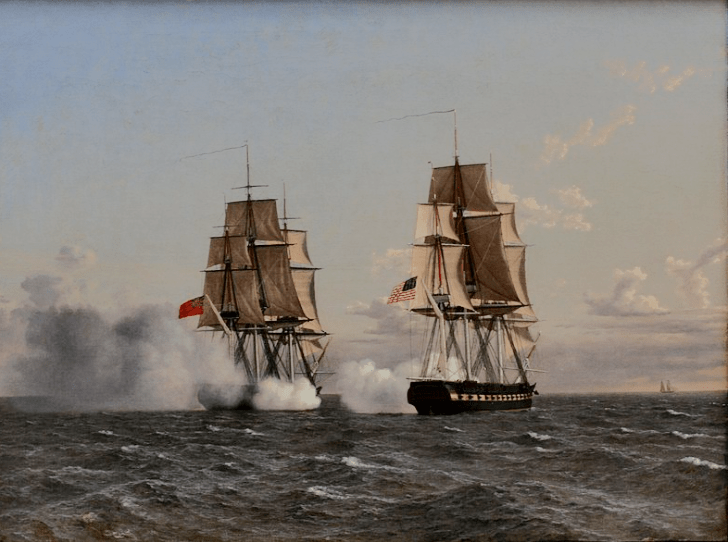
“Battle between English Frigate Shannon and American Frigate Chesapeake” (Danish painter, Christoffer Wilhelm Eckersberg, 1836; owner, Villy Fink Isaksen, public domain)
Captain Capel, commodore of the British squadron (that included the H.M.S. Shannon), reported the Shannon’s victory and capture of the U.S.S. Chesapeake in correspondence transmitted to the Admiralty in London. He included the report of the sea battle written by Captain Philip Bowes Vere Broke, commander of the Shannon.
Captain Capel’s letter to the Admiralty from Halifax, dated June 11, 1813, read:
ADMIRALTY OFFICE, JULY 10.
Copy of a Letter from the Hon. Capt. Cape!, of H.M.S. La Hogue, to
J. W. Croker, Esq. dated
Halifax, June 11, 1813.
SIR, – It is with the greatest pleasure I transmit you a letter I have received from Capt. P.V.B. Broke, of his Majesty’s Ship Shannon, detailing a most brilliant achievement in the capture of the United States frigate Chesapeake, in fifteen minutes, – Captain Broke relates so fully the particulars of the gallant affair, that I feel it unnecessary to add much to his narrative ; But I cannot forbear expressing the pleasure I feel in bearing testimony to the indefatigable exertions and persevering zeal of Capt. Broke, during the time he has been under my orders; and placing a firm reliance on the valour of his Officers and crew, and a just confidence of his system of discipline, he sought every opportunity of meeting the enemy on fair terms, and I have to rejoice with his country, and his friends, at the glorious result of this contest: he gallantly headed his boarders in the assault, and carried all before him. His wounds are severe, but I trust his country will not be long deprived of his services. – I have the honour to be, &c.
THOMAS BLADEN CAPEL, Captain, and
Senior Officer at Halifax
Saturday’s London Gazette by Express, Hampshire Telegraph and Naval Chronicle, Portsmouth, Hampshire, England, 12 Jul 1813, p. 4
***
OTHER ACTIONS BY CAPT. CAPEL’S ROYAL NAVY SQUADRON OPERATING IN NEW ENGLAND WATERS
The Portland Gazette recorded the hostile actions of Capt. Capel’s British naval squadron during the month of July 1813:
“MONDAY, July 19 – Arrived fishing schooners Wealthy, Snow, Cohasset with 91 seaman put aboard La Hogue Thursday last. They composed the crew of the brig William Howard, of and for Plymouth from Cadiz in ballast and the Swedish brig Worland from Portsmouth for St. Barts with a cargo of slaves, shooks and timbers. The former taken on Tuesday last; the latter of Wednesday. The William was set fire to on Thursday night, with part of the seamen’s clothes on board. Left La Hogue on Thursday night, 20 league’s E of Coffin’s Ledge. The W had been taken the same day, and was given up to bring the prisoners. The L H captured five other fishermen same day, and had them go in company of Dorphin, Whitcomb, of Cohasset; Two brothers Lombard Truro; ___ . Snow, do. ___, Watkins, Provincetown; another Provincetown schooner. The sails of the Dorphin had been taken off. The La Hogue boarded on Wednesday a small topsail schooner said to be from Boston for Halifax. Capt. Howard had a guard of soldiers placed over him, & was detained on board La Hogue. Ship Roxana was manned from L H and sent to bring vessels too.
“SAME DAY… Caledonia was taken by La Hogue and threatened to be burnt.. left LH… in company of Eagle, William, of Baltimore, from Lisbon for Boston; detained July 15, Roxana; schooners United States, Nichols, of Boston, from the West Indies, Worland; 3 sloops and five fishing schooners. On Sunday morning about 20 miles E of Boston Light was boarded by Rattler, sloop of war; another ship and the Tenados, frigate, in company. The Rattler had sent to Halifax a ketch from St. Barts to Boston, with rum, which had been permitted to proceed by La Hogue. It was expected the Eagle would be burnt. The William, of Plymouth, was burnt with all sail set – Capt Caple was in high spirits while she was burning.”
Shipping Intelligence – Port of Boston, Portland Gazette, Portland, Maine, 26 Jul 1813, p. 1
***
SEPTEMBER 1813 REBECCA AND ABIGAIL BATES: TWO SISTERS WHO PLAYED THE FIFE AND DRUM AT SCITUATE HARBOR TO WARD OFF H.M.S. LA HOGUE

Scituate Lighthouse at Cedar Point, Scituate Harbor, Massachusetts. (photo: John Tlumack, Boston Globe photographer, 1986) The Town of Scituate is located on the South Shore of Boston; it is known for its Harbor “par excellence.”
An article in Harper’s New Monthly Magazine published in 1878 recounted the heroics of the Bates sisters. The story was told by its chief heroine, Rebecca Bates. The article said:
“The story, taken from her own lips, can be depended upon as thoroughly reliable. Her father was Captain Simeon Bates; he was light-keeper at the time, and was the first who lit the light, in April, 1811. In the spring of the following year English cruisers were numerous in Massachusetts Bay, and on one occasion the launches of an English frigate were sent in to Scituate Harbor. They set fire to vessels at the wharves, and towed out two at the same time threatening to destroy the town if any resistance was offered.
“After this event a home guard was formed, and detachments were stationed on Cedar and Crow points, and in front of the village, with a brass piece. When there was no sail insight the guards were allowed to go off to their farms.
“Nothing to occasion alarm occurred again until the following September. Rebecca, at that time eighteen years of age, and her sister Abigail, fourteen years old, … were sitting toward evening sewing with their mother. Captain Bates and the rest of his large family and the guards were all away. Mrs. Bates told Rebecca it was time to put on the kettle. As Rebecca went into the kitchen she for the first time perceived an English ship-of-war close at hand and lowering her boats:
“I knew the ship at a glance,” she said. “It was the ‘La Hogue’.”
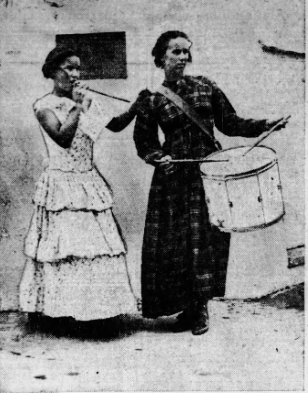
The Bates sisters: re-enactors: sisters Polly and Margaret Soule. (photo: Boston Globe, 1936)
***
“‘O Lord!’ says I to my sister, ‘the old ‘La Hogue’ is off here again! What shall we do? Here are their barges coming again, and they’ll burn up our vessels just as they did afore.’ “You see, there were two vessels at the wharf, loaded with flour, and we couldn’t afford to lose that in those times, when the embargo made it so hard to live we had to bile pumpkins all day to get sweetening for sugar. There were the muskets of the guards. I was a good mind to take those out beyond the light-house and fire them at the barges; I might have killed one or two, but it would have done no good, for they would have turned round and fired the village.”

A shore party in a long boat alongside a Royal Navy warship. (lithograph: public domain)
***
“‘I tell you what we’ll do,’ said I to my sister; ‘look here, says I, ‘you take the drum, I’ll take the fife.’
“I was fond of military music, and could play four tunes on the fife: ‘Yankee Doodle’ was my masterpiece. I learned on the fife which the soldiers had at the light-house. They had a drum there, too; so I said to her, ‘You take the drum, and I’ll take the fife.’
“‘What good’ll that do?’ says she.”
“’Scare them’, says I.”
“‘All you’ve got to do is to call the roll, I’ll scream the fife, and we must keep out of sight; if they see us, they’ll laugh us to scorn.’”
“I showed her how to handle the sticks, and we ran down behind the cedar wood. So ‘we put in’, as the boys say, and pretty soon I looked, and could see the men in the barges resting on their oars and listening. When I looked again I saw a flag flying from the mast-head of the ship. “My sister began to make a speech, and I said, ‘Don’t make a noise; you make me laugh, and I can’t pucker my mouth.’
“When I looked again I saw they had seen the flag, and they turned about so quick a man fell overboard, and they picked him up by the back of his neck and hauled him in. When they went off I played ‘Yankee Doodle.’”
“Is not this heroine, who saved two ships laden with flour, and perhaps other valuables from destruction, entitled to a pension? She has five brothers and sisters…”
Along the South Shore, Harper’s New Monthly Magazine, no.187, vol. 57, Harper and Brothers, New York, June 1878, pp 8-10
***
In September 1813, the Bates girls pretended to be a fife and drum contingent of a large local militia force sent to engage a raiding party from for the Royal Navy frigate HMS La Hogue intent on ransacking their village and destroying the Scituate Harbor wharf along with two flour ships. The sisters had concocted a clever stratagem that fooled the British naval captain and prevented the planned attack.
The tenacity, courage and pluck of sisters Rebecca and Abigail Bates deceived Captain Capel, master and commander of a British frigate H.M.S. La Hogue and ultimately saved Scituate Harbor from fire and destruction. Loudly playing fife and drum to the tune, “Yankee Doodle,” the girls – members of “the Army of Two” – hid in the shadows of nearby grove of cedar trees and pretended to be a much larger American militia force. They had hoodwinked the British and prevented the surprise attack by a raiding party from La Hogue. Fearing a counter-attack by the American militia, the British captain abruptly called off the raid. Then the mighty Royal Navy “74” frigate, its captain, officers and formidable crew abruptly sailed away.
The Bates sisters had saved the day! Their imaginative deception plan and its rapid execution had duped the British naval commander during the War of 1812. Their action offers a meaningful example of the overall purpose and power of deception in wartime.
***
BRUCE MCWHIRK 28 Dec 2023
 NauticaSpace Press