CAPTAIN COOPER B. BRIGHT’S REVOLUTIONARY
DRONE JET-POWERED, ‘ONE-WAY’, VTOL INFLATABLE AIRPLANE
FOR THE U.S. NAVY
By Bruce McWhirk
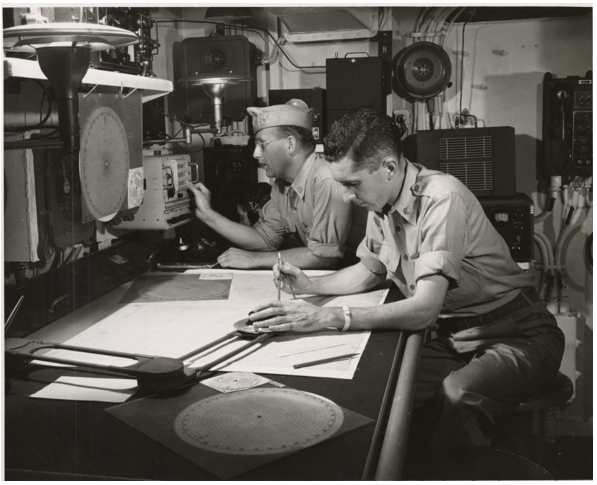
(photo: Patriot’s Point Naval and Maritime Museum.)
Captain Cooper “Coop” B. Bright, a U.S. Navy officer, was brave, self-confident, resolute and brilliant. He was well educated, having graduated from Rutgers University in 1931 with a BS degree in engineering; he was highly skilled in science and mathematics, and later in life became a member of the Operations Research Society, and a program manager for the Office of Naval Research (ONR.)
Coop’s Navy Career aboard U.S.S. Yorktown, aircraft carrier, during World War II – He coordinated waves of U.S. Navy combat planes in mass, swarm attacks.
“Coop” Bright joined the U.S. Navy Reserve shortly after Pearl Harbor and received a direct commission with the rank of Lieutenant. He served 34 months in the Pacific Theater as an Air Operations Office aboard the Aircraft Carrier U.S.S. Yorktown (CV-10), also known as “The Fighting Lady.” Working in the Air Pilot Office, he tracked and plotted the location of the Air Wing and its U.S. Navy pilots during some of the crucial and decisive Pacific battles against Imperial Japan. By the end of the war, Lieutenant Bright had earned 18 Battle Stars and won a Bronze Star with a Combat “V”.
Coop later testified before Congress about the concept of “Wagmight,” an inflatable VTOL airplane which could be configured as either a missile or one-way drone bomber. He said, “I was the hangar-deck officer [aboard U.S.S. Yorktown.] I am familiar with those operations, and I would say it gives us a chance to get back to what you remembered, where we had a mission aircraft to divebomb, we had aircraft to fight, and we had aircraft to drop torpedoes. It would give us a chance to go back to a mission aircraft which would mean the minimum amount of equipment to be folded.”
After serving 34 months on U.S.S. Yorktown until the end of the war, Lieutenant Bright was awarded 18 Battle Stars and won a Bronze Star.
Aboard Yorktown, Coop played a leading role in the sinking of the biggest battleship the world has ever known: The Imperial Japanese Navy’s Battleship Yamato.
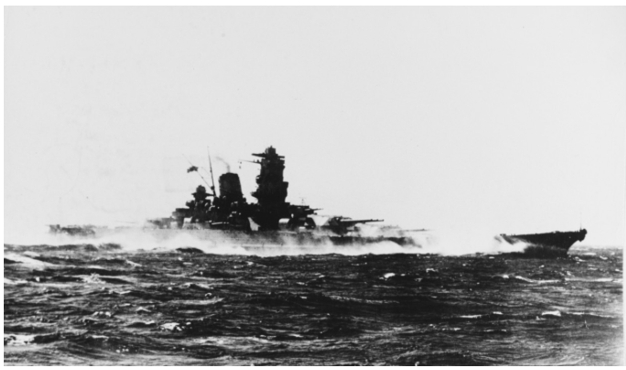
The Imperial Japanese Navy’s super- battleship Yamato during its pre-commissioning sea trials, 20 October 1941. (photo: U.S. History and Heritage Command.)
Sinking the Imperial Japanese Navy’s biggest warship: Battleship Yamato.
During World War 2 Coop learned many important lessons regarding the coordination of air attacks from aircraft carriers by swarming hundreds of U.S. Navy combat planes as torpedo planes and dive bombers.
During Operation “Ten-Go” on April 7, 1945, it took four distinct waves of relentless American air attacks to finally sink the Japanese super- battleship Yamato. Over 380 U.S. carrier aircraft launched from Task Force 58 and pounded the warship with at least 11 torpedoes and 6 heavy bombs before she capsized and exploded.
- First Wave (approx. 12:30 PM): U.S. dive bombers and torpedo planes struck the port side, destroying much of the ship’s anti-aircraft defenses and leaving the Yamato with a 5-degree list.
- Second Wave (approx. 1:00 PM): A larger force of about 50 planes targeted the ship, scoring multiple torpedo hits on both sides and increasing flooding. Counter-flooding managed to keep the ship afloat, but her speed was reduced to 18 knots.
- Third Wave (approx. 1:30 PM): Dive bombers and torpedo planes struck the superstructure and sides. Massive flooding and uncontrollable fires caused a severe 18-degree list.
- Final Wave (approx. 2:00 PM): A final strike of torpedo bombers hit the starboard side with deep-running torpedoes below the waterline. A final strike of torpedo bombers hit the starboard side with deep-running torpedoes below the waterline. This critical damage caused all power to be lost, and the Yamato rolled over and rapidly sank.
During this sea battle, Coop coordinated and issued the launch order by radio from Yorktown’s Air Pilot Office to the carrier’s Grumman TBF (and TBM) Avenger pilots.
At 1333, the Third Wave of another 110 aircraft was launched from TG 58.4 (Yorktown, Intrepid, and Langley) and commenced their attack on Yamato (following the first and second waves of 280 aircraft.) This time, all attacks concentrated on the battleship. Twenty Avengers attacked from the port side (concentrating torpedo attacks from the port side was deliberate, with the intent to capsize the ship). Three of the torpedoes hit in quick succession, and Yamato took on another 3,000 tons of water and a 7-degree list. Having already counter-flooded to starboard, the only option Yamato had was to flood her starboard engine and boiler rooms. The desperate measure worked, but, with insufficient time to give warning, several hundred Yamato crewmen were drowned as a result, and the ship was slowed to 10 knots, which made her an easier target.
Rear Admiral Samuel J. Cox, Director, Naval History and Heritage Command (NHHC, H-044-3: “Operation Heaven Number One” (Ten-ichi-go)—the Death of Yamato, 7 April 1945, Apr 2020
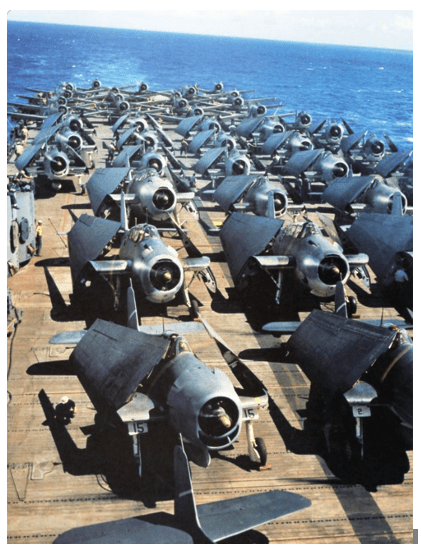
FOLDED-WING COMBAT FIGHTERS ON AN AIRCRAFT CARRIER’S FLIGHT DECK, THE STERN: Grumman F6F-3 Hellcats with mechanical folded wings on U.S.S. Yorktown (CV-10) flight deck in November 1943. These combat warplanes performed missions in mass, swarm attacks on Japanese targets. (Still shot from Hollywood’s Academy Award-winning documentary move, The Fighting Lady (1944.)
The Grumman TBF (and TBM) Avenger was the US Navy’s primary torpedo bomber during World War II. Operating extensively off the USS Yorktown (CV-10), these rugged, three-seat aircraft carried heavy payloads and were famously involved in major strikes, including the sinking of the Japanese battleship Yamato in 1945.
U.S.S. YORKTOWN WAS ATTACKED BY A JAPANESE KAMAKAZEE BOMBER
The U.S.S. Yorktown (CV-10), the Essex-class aircraft carrier famously known as The Fighting Lady, was attacked by Japanese kamikaze aircraft during World War II, though it did not suffer catastrophic damage.
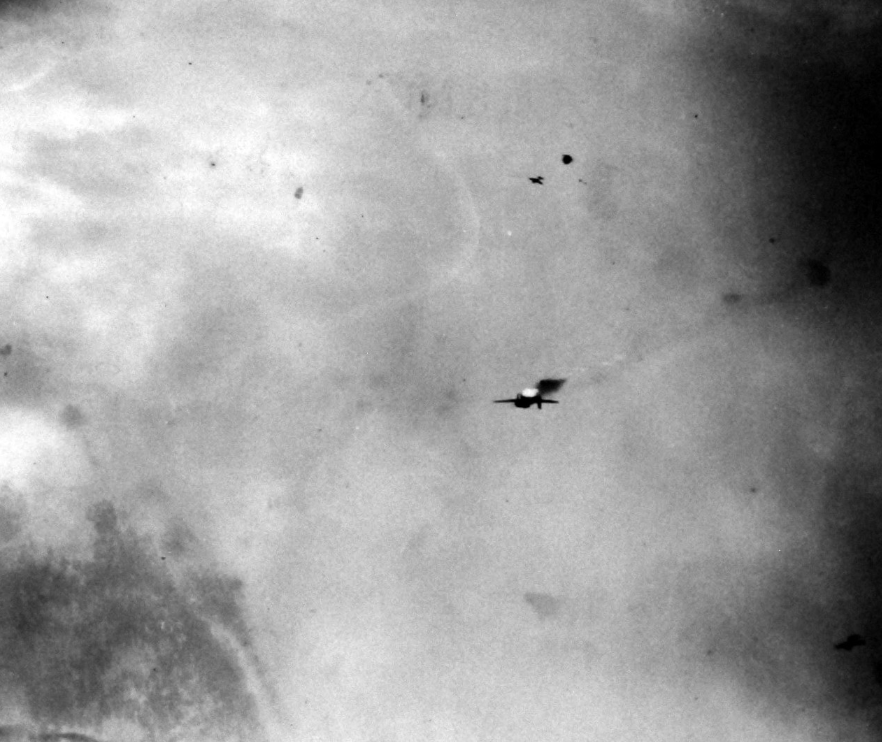
U.S.S. Yorktown (CV-10), March 29, 1945. A flaming Japanese Yokosuka D4Y “Judy,” a kamikaze dive bomber hit by anti-aircraft fire from the aircraft carrier as it was being hotly pursued closely in its dive by a U.S. Navy F6F. The enemy aircraft missed the port flight deck of the aircraft carrier and crashed into the sea. The F6F also crashed into the sea 100 yards astern of the aircraft carrier. photo: 80-G-333743: U.S.S. Yorktown (CV-10), March 29, 1945, U.S. Naval History and Heritage Command / Official U.S. Navy photograph, now in the collections of the National Archives.
En route to Okinawa, Yorktown came under attack by a Japanese Yokosuka D4Y “Judy” dive bomber, part of a broader kamikaze swarm assault on Task Force 58. The kamikaze bomber aircraft passed over the flight deck and exploded, only after it had dropped a bomb on the signal bridge. The onboard explosion reigned down gasoline and debris, and started fires on the hangar deck, but did not cripple the aircraft carrier.
“COOP” – THE FUN MASTER
The day Coop joked with Hollywood Actress, “Bombshell” Rita Hayworth at a party for V.I.P.s. – He was a renown “Fun Master.”

Rita Hayworth, Hollywood actress and glamour girl. (photographer: Robert Coburn, promotional photo for the movie Gilda, Screenland, vol. 50, no. 8, June, 1945, p. 71.)
On April 29, 1949, Coop “Broke the Ice” at an exclusive onboard-ship buffet party for V.I.P.s in Cannes, France, hosted by a Vice Admiral Forrest Sherman, Deputy Chief of Naval Operations, (much to the glee and enormous satisfaction of his arch-rival, Rear Admiral J. J. “Jocko” Clark).
Naval historian Clark G. Reynolds told the humorous story:
“Rear Admiral J. J. ‘Jocko’ Clark’s wife Shannon flew in to rub elbows with Europe’s social elite on the Riviera, notably movie actress Rita Hayworth, being courted by Prince Aly Khan of Pakistan, as both vacationed at Cannes. One thing on which Admiral Sherman insisted was the good behavior of all personnel ashore, essential to enhancing the image of the United States in the Cold War. Clark took advantage of the visiting celebrities to entertain them with a buffet supper on board the Philippine Sea (Aircraft Carrier CV-47) the evening of 29 April 1949. Sherman and other admirals attended, forcing Jock to stay on his best behavior.
“The combination of such disparate personalities as admirals, royalty, millionaires, and the Hollywood set was accentuated by the presence of social butterfly Shannon Clark as official hostess and a former wartime shipmate on the “new” Yorktown (CV-10) when Jocko had been her captain. This was the humorous yet superb Commander Cooper B. Bright, executive officer of the transport Winston, also at anchor.
“Bright regarded the party as ‘stupid,’ everyone just standing around chatting after dinner. ‘It doesn’t have to be that way,’ thought this bald-headed master of ‘Grabass.’ He took aside the glamorous Rita, whom Life magazine had recently dubbed ‘the Love Goddess’ for her steamy films Gilda and Down to Earth.
“’When the admirals stop talking,’ Bright quietly briefed the gorgeous long-haired Hayworth, ‘I’ll ask you, ‘If you had met me before you met Aly Khan, and if I’d preferred marriage to you [instead of my wife], what would your answer be?’ And you say, ‘I would select you over Aly Khan in a day.’ And I’ll say, ‘Why would you do that?’ And you say, ‘Because you have more face to kiss.’ She agreed at once and ‘skinhead’ Coop remarked, ‘I think we can break the ice.’
“At the next lull in the conversation, Bright, standing on the opposite side of the room from Hayworth, said loudly, ‘Rita!’ All chatter stopped, especially since only the admirals were supposed to address the actress by her first name. The two went into their routine. Rita, consummate actress that she was, not only remembered her lines perfectly but gave them ‘the real play.’
“The place ‘went up in smoke,’ recalled Coop, with everyone laughing uproariously. When it died down, Jocko bellowed, ‘Goddam you, I’ll bet he paid her to say that!’ Then came more laughter, whereupon Bright seized the moment. He said to Rita that during the war he had been ‘the Pacific Ocean Area Sex Typhoon,’ a boast that he, happily married, had used to rib the Yorktown’s lonesome pilots. ‘And you are the ‘goddess of love.'”
Clark G. Reynolds, Cherokee Jocko Fights the Cold War, Naval History Magazine, Volume 19, Number 3, U.S. Naval Institute, Annapolis, Maryland, June 2005
CAPTAIN BRIGHT’S RESEARCH AND DEVELOPMENT OF THE ONE-WAY DRONE “WAGMIGHT” INFLATABLE AIRPLANE
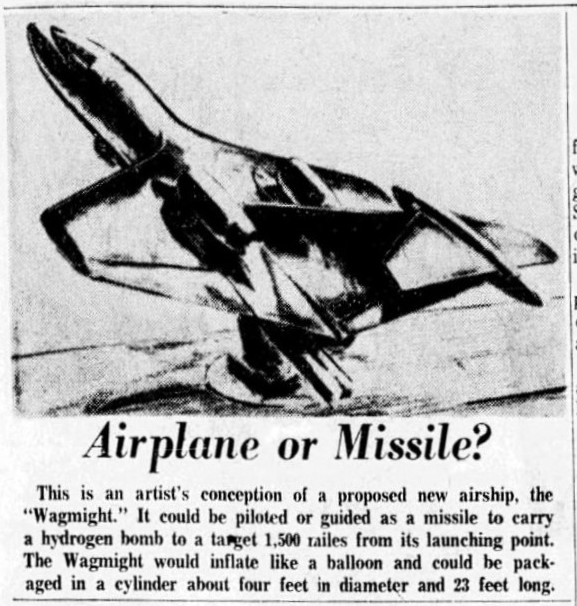
“INFLATABLE AIRPLANE” was a mockup sketch that appeared in “WASHINGTON SCIENCE TRENDS” in 1959. (graphic image: Rockford Register Star, Rockford, Illinois, 18 Dec 1959 p. 3)
The original UP caption accompanying this rough drawing read: “INFLATABLE AIRPLANE- This is a sketch of a proposed inflatable (like a balloon) airplane which Washington Science Trends says the Defense department la considering. could be used as an H-bomb guided missile, as a 500-mph strategic mission craft, and could take off from ship or submarine. Packaged, it would be 28 feet long, four feet in diameter.”
(N.B. “WASHINGTON SCIENCE TRENDS,” National Press Building, Washington, D.C., was a long-running, independent weekly newsletter which collected and published information on R&D programs of, by, or for the Federal Government, including DOD. Arthur Kranish was its founder, publisher, and editor. He operated Trends Publishing and was a well-known science journalist who steered the publication for decades, covering government research, defense technology, and aerospace developments.)
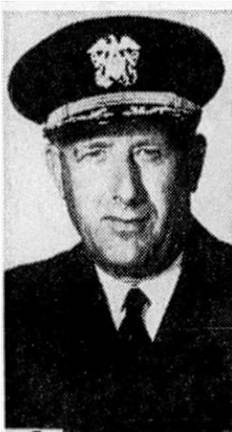
Captain Cooper B. Bright, U.S.N., Office of Naval Operations. He served as a U.S. Navy Program Manager at Goodyear Corporation in Akron, Ohio where “Wagmight” Inflatable Plane was developed. (photo: The Evening Sun, Baltimore Maryland, 25 May 1961, p. 4.)
Following the war, Coop saw sea duty with two tours in the Amphibious Forces as Commander of USS Whitemarsh (LSD8), and sea duty in 1954 as Commander of the USS Wrangel (AE12), an ammunition ship in the Mediterranean. Thereafter, Captain Bright was assigned to two tours working for the Office of Naval Research. He spent six years in the Office of Naval Research (ONR) as program manager, working with Goodyear Corporation in Akron, Ohio, where he was in charge Wagmight” Inflatable Airplane project.
An Associated Press (AP) syndicated story later reported:
“Bright said that in 1958 a study group was set up within the Navy, including people from the [Goodyear] Aircraft Co., which had experience in small inflatable plane construction. Goodyear was assigned the job of looking into the feasibility of building large craft for military use. The Navy version is slightly different. It says it asked Goodyear to investigate the feasibility of the project and that ‘Goodyear made a study which they voluntarily gave to the Navy for consideration.’ Bright was appointed the Navy’s project officer.’”
Navy Vet Bucks Brass on Plane, The Tennessean, 25 May 1961, p. 10
CAPTAIN COOPER B. BRIGHT MADE HIS CASE FOR WAGMIGHT INFLATABLE PLANE AND IT APPEARED IN THE NATIONAL PRESS – THIS STORY CREATED CONTROVERSY IN THE COURT OF PUBLIC OPINION
In 1960 Captain Cooper B. Bright’s concept for the Wagmight Inflatable Airplane was presented to the nation’s press and to the American people. Drew Pearson, America’s Number One Investigative Reporter, filed this syndicated national news story about the controversial invention:
DREW PEARSON – WASHINGTON MERRY-GO-ROUND
(TYPED NEWS COPY – MANUSCRIPT – AMERCAN UNIVERSITY ACHIVES)
12 Jan 1960
Admirals Oppose Latest Missile, Makes All Ships Plane Carriers
WASHINGTON – Goodyear Tire has developed a cheap, rubberized, collapsible missile that could transform every Navy ship into an aircraft carrier and every large army truck into a missile base.
Yet this remarkable weapon has become so snarled in red tape that it may never go into production. Loudest objections have come from admirals who refuse to admit that their great, costly floating palaces will ever become obsolete.
The Wagmight missiles, as they are called, can be stored in six small cylinders which can be packed in quantity aboard the smallest ship. In less than an hour, a missile can be assembled, inflated, and launched from a simple catapult that can be installed even on PT boats and trucks.
Except for the jet engines and landing gear, Wagmight would be constructed entirely of neoprenecoated nylon cloth which can withstand intense friction or rough handling. Damage can be repaired with simple tire patches instead of the costly welding and riveting required for metal weapons.
Once inflated, the Wagmight could be riddled with bullets without losing pressure.
It has a range of over 1,500 miles and can hug the terrain at an altitude no more than 500 feet. This means it could skim over the treetops, too low to be picked up in advance by radar which have trouble spotting the nonmetallic fabric anyway.
Biggest drawback: the Wagmight would not be able to fly over 500 miles an hour, slow enough to be shot down. But because of the low cost, the missiles could be released in such swarms that no enemy could fight them off. The penetration rate at low altitudes is said to be over 90 per cent.
The same tested guidance system now used in Matador missiles would take the Wagmight unerringly to its target. Or the Wagmights could be piloted if the Navy wished to use them for reconnaissance.
Every submarine fleet could be loaded with dozens of them for a fraction of what it costs to build Polaris submarines which can carry only 16 metal missiles. Trucks and trains could also be easily equipped to launch Wagmight missiles, thus giving us hundreds of land bases whose locations could never be fixed.
These missiles could start rolling off the production line like World War II jeeps in 12 months. But the opposition of the admirals, who prefer more expensive weapons, has stalled final approval.
The man now debating final decision is Dr. Herbert York, the Pentagon’s engineering, and research chief.
THE U.S. NAVY’S TOP BRASS REJECTED THE CONCEPT OF WAGMIGHT INFLATABLE PLANE
After the news story broke about the Wagmight Inflatable Plane and stirred a public debate, news surfaced that the Navy top admirals had rejected the idea. Chairman Carl Vinson, D-Ga., of the House Armed Services Committee, and Rep. Jeffery Cohelan, Calif., a committee member, both sent written separate letters to Secretary of the Navy John B. Connally asking for an explanation.
Fred S. Hoffman, Washington (AP), Says Data on New Plane Destroyed, Sioux City Journal, 25 May 1961, p. 1
CAPTAIN BRIGHT SAID HE WAS ORDERED TO DESTROY MATERIAL ABOUT THE VTOL INFLATABLE AIRPLANE; A YEAR LATER, HE RECEIVED ORDERS TO BE TRANSFERRED TO A “DEAD END JOB”
Washington, May 25 [1961] Representative Flood (D., Pa.) said today he has asked the Navy to halt the transfer of Capt. Cooper B. Bright until Congress can investigate Bright’s dispute with certain admirals over an inflatable plane project. Flood, member of the House subcommittee handling defense appropriations, said he has so written to Secretary of the Navy John B. Connally.
He said he told Connally the veteran captain’s transfer should be set aside ‘until such time as responsible congressional committees can examine the project further on its merits’ and until it can be determined whether the transfer ‘could be attributed to this operation.’
Says He Destroyed Data
Bright, who once headed a Navy industry study of the inflatable plane concept, said that on orders from superiors last November he destroyed data on a new version designed to take off straight up from virtually any kind of ship. At the same time, he said, he was directed to talk to nobody about the -an order he said was relaxed in February to allow off-duty conversations. Bright contended the novel idea was suppressed. He said some admirals feared it posed a threat to the future of carriers.
Admirals Are Named
During testimony before House committees… Bright clashed with Vice Adm. John T. Hayward, Deputy Chief of Naval Operations for Development. Hayward said he rejected the project in a and defended his action as ‘a sound decision.’
Bright said that during this time he was told by Adm. James S. Russell, Vice Chief of Naval Operations, to stop said that pushing the- project.
Bright said that last month three days after making a formal new pitch for the project to Connally and Adm. Arleigh A. Burke, Chief of Naval Operations–he was ordered to report in June to a new post as Inspector of Navy Material in San Francisco.
He regards this assignment as just about the end of the line. He now is attached to Navy’s Logistic War Plans Branch, where he was moved more than a year ago after being relieved as project officer on the inflatable plane study. and defended his action as ‘a sound technical decision.’
Halt Transfer in Plane Dispute, Navy Urged, Evening Sun, Baltimore, Maryland, 25 May 1961, p. 4
1960 CAPTAIN COOPER B. BRIGHT TESTIFIED BEFORE CONGRESS
CONGRESSIONAL HEARINGS HELD ON THE WAGMIGHT INFLATABLE AIRPLANE
Captain Bright said at the Congressional Hearing: “I feel very strongly, and I have for over 2 years, that this program offers a real opportunity to increase our defense posture to utilize the ships that we have today in our Navy to greater advantage in increasing the offensive and defensive capabilities of our fleet.”
When asked of what gain the Wagmight Inflatable Plane could bring to the U.S. Navy, Captain Cooper instantly replied:
“The gain as our study shows, is primarily, in major part, the foldability…[It] is inherent in fabric construction. It is the foldability that is the big and major factor that is making this advantageous to use as a weapon with ships at sea.
“We don’t fold the equipment, but we provide for it to be packaged as the wings and fuselage fold down into its plastic base or package.”
“I was instructed when I came over here to advise the committee that I could answer any questions and give any information that they desired.
“However, I would be speaking for myself and not the Navy, as Admiral Hayward [VICE ADM. JOHN T. HAYWARD, DEPUTY CHIEF OF NAVAL OPERATIONS FOR DEVELOPMENT] would speak officially for the Navy. But I would like to point out that what I say will not be my opinion, it will be based on the very extensive study done in the Navy and by the Navy and not by the Goodyear Aircraft Co. … I don’t think I should say any more now until we get into the presentation, but I think I can satisfy the committee that due diligence has been exercised and the procedures that are legal and orderly have been followed and that their time will be well spent to hear the presentation.”
Testimony of Captain Cooper B. Bright, U.S.N., Hearings on Wagmight Inflatable Plane, Committee on Science and Astronautics, U.S. House of Representatives, Afternoon session, 09 Feb 1960, p. 607
JOSEPH PIPITONE, MANAGER, AIRCRAFT ANALYSIS GROUP, GOODYEAR AIRCRAFT CO. OFFERED FURTHER CLARIFICATIONS ON THE WAGMIGHT INFLATABLE AIRPLANE AT THE CONGRESSIONAL HEARING
At this same Congressional Hearing, Joseph Pipitone said:
“I am a manager of the aircraft analysis and development group at Goodyear Aircraft.
“[Wagmight Inflatable Plane] was designed with the concept that it would be zero launched and that it would land in the water on its return flight, if it was a manned aircraft.
“If it was an unmanned aircraft, then, of course, it is a one-way trip.
“We did furnish the technical information and we thoroughly believe that it is feasible, we know that it is feasible and we feel that it is well within the present state of the art, for the speed range wherein this vehicle’s mission was to be accomplished.
“We know that we can do this up to around 400 knots. That is, I would like to clarify that a little bit, in that we have been asked many times why did we select 400 knots? When we were approached on this, and, of course, the people who were making this study would like as great a speed as they could possibly get. This allows a greater probability of penetration, and so on. So we put the limit-we did not feel that we could take the next logical step at a speed in excess of 400 knots. This is primarily due to the fact that above these speeds, when you put in the limiting dive speed of an aircraft with this cruise speed, that you are just below the speed range or Mach number, wherein you would get the compressibility effects of the air and the attendant aeroelastic problems.”
“Mr. FULTON [Congressman James G. Fulton, Pennsylvania] When you inflate it, it is a normal size airplane; that is right.
“And it is then chiefly in the storage at the hangar deck level, it is not in an operational status nor in a repair status, but for storage that you save this amount [of deck space.]
Mr. PIPITONE. Precisely right, from a logistics and handling and that sort of point.
Mr. FULTON. On the handling of it, how do you handle it differently on the hangar deck from the ordinary type plane?
“Mr. PIPITONE. Well, you could have this capsule, or the container which holds it, on a dolly of some type and you can roll it around without having the objections of the damage that usually is imposed on aircraft being handled on the hangar deck. That is wing tips get dented, they meet obstructions, one airplane [with a mechanical folded-wing configuration] hits another. I am sure from your experience on a carrier you know what I am talking about here.”
After the public testimony by the witnesses was completed, the Congressmen and witnesses went into Executive Session to discuss the classified “Secret” details and issues surrounding the Wagmight Inflatable Airplane project.
Testimony Joseph Pipitone, Hearing on Wagmight Inflatable Plane, Committee on Science and Astronautics, U.S. House of Representatives, Afternoon session, 09 Feb 1960, p. 607
“BREAKTHROUGH” THE VERTICAL TAKE-OFF AND LIFT – THE NAVY’S TOP BRASS ORDERED THE PAMPHLETS PROMOTING THIS INVENTION TO BE DESTROYED
On 25 May 1961 The Tennessean reported:
“Bright and Hayward testified side by side before the House Space Committee and a House appropriations subcommittee. They took opposite positions.
Hayward told the appropriations group he had decided ‘not to go forward’ with the projects. He said, ‘I do not believe the state of the art is such that make a tactical aircraft packaged.’
“However, he assured the committee that ‘I will certainly continue to look at it.’
“Bright argued the project ‘has the potential of revolutionizing the defense posture of the United States greatly increasing our capabilities in both limited and nuclear war while affording substantial savings.’
“REP. GEORGE Mahon, D-Tex., chairman of the appropriations subcommittee, recalled that the exchange between Bright and Hayward behind closed doors was ‘more heated than the record reveals.’ Bright told a reporter that during this period he had stormy sessions with Russell [Admiral James Russel, Vice Chief of Naval Operations] in which, he said, the admiral told him to stop pushing the project. Meanwhile, Bright was reassigned to the Navy’s logistic war plans branch, where he is now serving as plans coordinator. But he said he was given authority by his superior, Capt. Joseph Koenig, to continue work on the inflatable plane project in his off-duty hours.
“’The upshot, Bright said, was that last summer [1960] he and industry people scored what he called a breakthrough–they hit on what he said was a way to make the plane into an effective vertical takeoff and landing craft.
OTHER NAVY sources denied it was much of a breakthrough. Bright said he took up the matter with Hayward and was told to pursue it, to draw up pamphlets, specifications and other promotional material. But in mid- November last year [1960], he said, orders came down, through Koenig to destroy that material.
“At the same time, Bright said, he was told to talk to nobody about the matter. Last February [1961], the captain said, he was given permission to talk about the project during off-duty hours.
ON APRIL 11, Connally delivered a talk to a hall full of naval officers here, and said at one point: “I call upon each of you to exercise your initiative, to move ideas out into the open with boldness and courage.”
Bright said this speech prompted him to prepare a special presentation on the vertical takeoff-inflatable plane project for Connally. Three days after he submitted it, Bright said, he received a phone call telling him orders had been drawn up sending him to the San Francisco post.”
Navy Vet Bucks Brass on Plane, The Tennessean, 25 May 1961, p. 10
Hearings on Wagmight Inflatable Plane, Committee on Science and Astronautics, U.S. House of Representatives, Afternoon session, 09 Feb 1960, p. 607 – 615
TECHNICAL CHARACTERISTICS OF CAPTAIN BRIGHT’S “BREAKTHROUGH” A JET POWERED VERTICAL TAKE-OFF AND LIFT (VTOL) INFLATABLE AIPLANE (AS REVEALED IN THE PRESS)
The “ACCUMULATOR” Principle
WASHINGTON (AP) – The navy has patented its “Wagmight” inflatable airplane, the controversial aircraft which the inventor says is being fought by admirals who fear it as a threat to the role of big carriers. The navy also reportedly completed a “full and unbiased” review of the plane’s capabilities as presented by its persistent inventor, Capt. Cooper B. Bright. Results of the review have not yet been disclosed.
Keeps Non-Military Rights
In taking out a patent last week on the “accumulator” compressed air principle, the navy reserved the nonmilitary commercial rights for Bright. The “accumulator” principle is intended to give fabric-fashioned, inflatable aircraft vertical takeoff capability.
…Bright believes the aircraft could be stored, in collapsed form, aboard merchant ships, destroyers or any sort of vessel, to be inflated and launched when needed…
More Pressure, More Lift
“Bright told the admirals that since it takes only 50 pounds of air pressure per square inch to inflate a fabric airplane, the increase of that pressure to 150 pounds would provide a tremendous source of additional power. Bright said the compressed air could be heated to 1,000 degrees the same temperature as the engine exhaust gases and mixed with those gases for a short spurt to double the lifting power at takeoff.
‘He said that since the ‘accumulator’ of the compressed air is the airplane structure itself, this doubled power is achieved without any increase in aircraft weight.
Wins Support
Bright has won the support of a distinguished Navy officer, retired Vice Adm. T. G. W. “Tex” Settle, veteran of 100 balloon flights in one of which, in November, 1933. he ascended to a record of 61,237 feet. Settle, commander of amphibious forces of the Pacific fleet at the time of his retirement in 1956 said he considers Bright’s invention ‘a technological breakthrough of tremendous potential.’”
Vern Haugland, NEARLY SCUTTLED Bright’s Inflatable Plane Patented After Navy Review, 21 Aug 1961, p 1
CAPTAIN COOPER B. BRIGHT APPEALED HIS CASE TO THE WHITE HOUSE
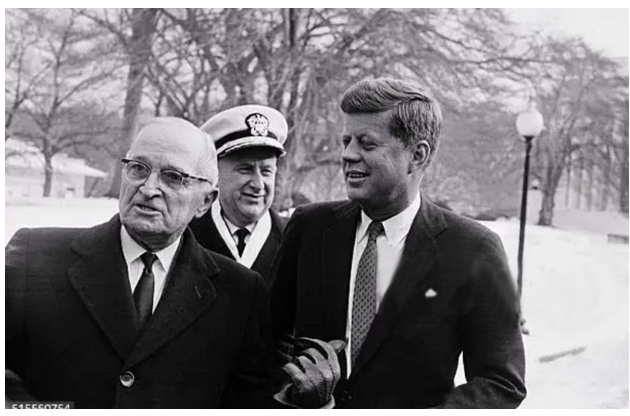
Ex-President Harry Truman (left) and President John F. Kennedy (right), together on inauguration day, January 20, 1961. Captain Cooper B. Bright (background) served as naval aide to former President Harry S. Truman during the Kennedy inauguration. He said this one-day duty was his favorite assignment of his entire Navy career. (photo: National Archives.)
KENNEDY’S AID ASKED ON INFLATABLE PLANE WASHINGTON. (AP)
A veteran Navy captain, claiming he has been balked at every turn, has appealed to President Kennedy to order further study of an inflatable plane concept the Navy has rejected.
Capt. Cooper B. Bright, who said he is being forced into retirement at the end of June, wrote Kennedy that all attempts to obtain action through the chain command “have resulted in endless referral and have been of no avail.”
The 53-year-old Bright, who has been in the Navy more than 20 years, also asked the President to order retraction of what he said was an untrue Navy statement “that now exist as a public prejudicial to me”
In its statement last the Navy said Bright had prepared a brochure and had it printed at government expense “for the apparent purpose of promoting his idea outside the Navy.”
In his letter to Kennedy, Bright said that at no time was the inflatable plane promoted by him as a private idea, adding,” Repeated efforts on my part to have these erroneous charges erased have been unsuccessful.”
Bright’s letter, dated April 2, was sent to the White House through channels.
The Navy sent along a memorandum reportedly restating its that there is no operational requirement for such an inflatable fabric-bodied plane which backers claim could take off vertically from almost any kind of surface ship. It declined to make the memo public.
Bright, a native of Wildwood, N.J., charged last May that the project he has been pushing for more than four years was squelched because, he said, certain admirals feared it might threaten the future of aircraft carriers. In his letter to Kennedy, Bright in effect repeated his charge without naming names.
Contending that studies have indicated his concept has real promise, Bright told Kennedy:
“The success of this project would not only provide a of aircraft urgently needed for guerrilla warfare in such areas as Viet Nam but would represent a significant increase the over-all offensive and defensive capability of our military forces.”
He said that “although only three months remain before I am forced to retire from the naval service, it is possible to form a dedicated and enthusiastic study group which could complete” by June 30 analyses of the power potential of the inflatable plane concept.
The chances are excellent, Bright assured Kennedy, that the results will be sufficiently convincing to warrant construction of a prototype for test and evaluation.”
KENNEDY’S AIDE ASKED ON INFLATABLE PLANE, Corpus Christi TX 18 Apr 1962, p. 16
***
ENTHUSIASM AT THE PENTAGON
Washington Post, Editorial page, May 27, 1961, p. A12
The idea of launching inflatable aircraft from submarine carriers seems altogether fantastic, but so much of weaponry is so fantastic that one laughs off visions like this at high peril. A Navy research engineer, Captain Cooper B. Bright, asserts that such an aircraft can be built, and furthermore, it can be made to take off vertically. Captain Bright also asserts that his superiors attempted to stifle this project because they feared it could jeopardize the future of more traditional carriers the Navy cherishes.
This is a serious charge. It is gratifying to see that both the House Armed Service Committee and the Pentagon have taken it seriously. Committee chairman Vinson wrote to Secretary of the Navy Connally, who promptly summoned Captain Bright, the admirals who had rejected his proposal and civilian research officials in an all-day meeting.
The public question here is whether imagination and enthusiasm can be cut off, when they threaten the objects of senior officers’ affections. Secretary Connally does not believe it happened in this case. But he directed Captain Bright to put his design in a Defense Department competition where the Army and the Air Force will also judge them.
Following the initial appearance of betrending, several reassuring aspects have emerged: Captain Bright’s determined to stand up for an idea in which he believes, the readiness of Mr. Vinson to ask questions on behalf of an impeccable research project, and the vigor of Secretary Connally in pursuing fair answers.
1961 CAPTAIN COOPER “COOP” B. BRIGHT WAS “SELECTED OUT” FOR PROMOTION
Due largely to the public controversy surrounding the Wagmight VTOL Inflatable Plane, Captain Bright was “Selected Out” for promotion to Rear Admiral and forced to retire from the U.S. Navy in June 1962 after more than twenty years of naval service.
“A Navy board has ‘selected out’ Captain Bright, which in land-lubber language means the controversial officer has been given a year to resign or be forced out of the service. Captain Bright, upon receiving this order, said he had no comment to make on the action of the board. ‘I intend to spend the next year proving that Wagmight is the best thing that ever happened to the Navy,’ news dispatched quoted him. The board which scuttled Captain Bright was headed by Vice Adm. Page Smith, Commander-in-Chief United States Naval Forces, Europe.”
“REPORTS from Washington say the potential of Wagmight as a VTOL (vertical take- off and landing) aircraft have increased greatly since Captain Bright first suggested the revolutionary idea. And now comes the shocker: ‘The Navy is getting rid of Captain Cooper. B. Bright, despite encouraging prospects of Wagmight,’ a news dispatch said earlier this week.”
CAPT BRIGHT’s PLIGHT, Delta Democrat, Greenville Mississippi, 16 Aug 1961, p. 4
A LASTING LEGACY?
“Very few persons have heard of Capt. Cooper B. Bright of the United States Navy. Neither had many persons heard of General Billy Mitchell before he became a controversial figure in his campaign for a strong air force, nor had they heard of Admiral Hyman Rickover until he battled Pentagon brass to ‘become the father of the atomic submarine…
“Captain Bright is the ‘father’ of a highly controversial collapsible missile aircraft. As such, he has been a thorn in the. Navy’s side for the past three years. He headed a 1958 study group which came up with the Wagmight concept to make every ship in the Navy a carrier of collapsed planes and missiles.
“REPORTS from Washington say the potential of Wagmight as a VTOL (vertical take-off and landing) aircraft have increased greatly since Captain Bright first suggested the revolutionary idea. And now comes the shocker: ‘The Navy is getting rid of Captain Cooper. B. Bright, despite encouraging prospects of Wagmight,’ a news dispatch said earlier this week.”
CAPT BRIGHT’s PLIGHT Delta Democrat, Greenville, Mississippi, 16 Aug 1961, p. 4
***
NAVAL SCIENTIST PRODUCE NEW INFLATABLE AIRPLANES
By VERN HAUGLAND, Washington. (AP)
El Paso Times, El Paso, Texas, 21 Nov 1960, p. 11
Naval Scientists have come up with a new idea for inflatable airplanes vertical takeoff and descent.
The Navy has not yet approved the idea, but a pamphlet on the project – an expansion of the Wagmight program for an inflatable airplane – has been distributed throughout the aircraft industry.
The Wagmight principle, in circulation for more than a year, has not won approval but the new concept calls for application of the principle of vertical takeoffs and landings (VTOL) or takeoffs and landings (STOL).
The standard VTOL – STOL technique requires powerful engines to provide lift – either through jet streams or propellor – to take the craft directly off the ground to land it gently. This power is an addition to that required for forward flight.
The new Navy technique would store compressed air from the regular engines in the inflatable wings of a rubberized aircraft beyond the pressure needed to keep the wings inflated in flight. A Navy study said that while a pressure of 50 pounds per square inch would be needed to maintain the shape of a rubber airplane wing in flight, the wings could be safely over-pressured to 150 pounds a square inch.
The surplus air would be released through downward-directed propellors to provide vertical take-off lifts.
The Navy study estimated that a seven-second blast of pressurized air would lift a plane to an altitude of 80 feet where it would be ready for forward flight.
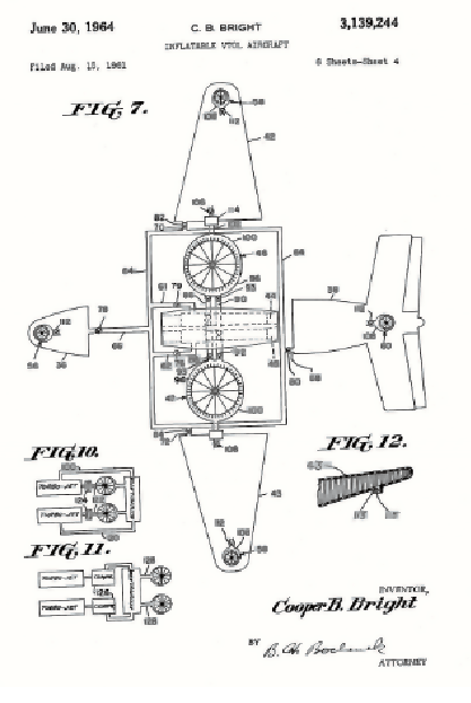
A view of the underside of the commercial version of The Wagmight “Inflatable VTOL Plane” invented by Captain Cooper B. Bright, U.S.N. His patent (US Patent 3,139,244) on this revolutionary drone or crewed aircraft was awarded and issued by the U.S. Patent and Trade Office (USPTO) on 30 June 1964.
This principle would do away with the need for additional engines required in other VTOL-STOL designs.
The Navy proposal calls for twin-engine turboprop aircraft with its body and wings of neoprene fabric, weighing about 15, 000 pounds with 3,900 pounds of fuel and a 3,000-pound payload. The plane, 43 feet long, 16 feet high and having a wing span of 36 feet would cruise more than 370 miles an hour with a range over 500 miles. Such a twin-jet low altitude attack plane could be packaged in six units for storage aboard a submarine, the Navy study said.
It added that:
1. The Tunney Regulus missile submarine could accommodate about 20 Wagmight aircraft, while the submarine Grayback could accommodate more than 60 Wagmights.
2. The Thetis amphibious warfare ship [USS Thetis Bay (CVE-90/CVHA-1/LPH-6), the United States Navy’s first dedicated assault helicopter aircraft carrier carried about 40 helicopters], could with the use of only half its hangar deck accommodate 145 VTOL-STOL Wagmights.
3. By substituting Wagmights for more than 80 metal airplanes now aboard the carrier Forrestal, and using only half the hangar deck space, 1,000 aircraft could be packaged and accommodated aboard–a reserve from which to resupply other ships in the fleet. The pamphlet said the deflated planes could be readily hidden ashore, delivered to troops by parachute and transported easily by small trucks or even jeeps.
***
A prototype of the Wagmight Inflatable VTOL plane was never constructed and tested.
Testimony of Joseph Pepitone, Hearings on Wagmight Inflatable Plane, Committee on Science and Astronautics, U.S. House of Representatives, Afternoon session, 09 Feb 1960, p. 613
CAPTAIN BRIGHT DISPUTED A U.S. GOVERNMENT STUDY THAT ANALYZED THE POWER POTENTIAL OF THE COMPRESSED AIR USED TO LIFT THE INFLATED VTOL AIRPLANE
Captain Bright sent a personal letter to President John F. Kennedy, addressed to the White House, in which he claimed that The Institute for Defense Analysis (IDA) study, in reviewing the Wagmight inflatable plane’s accumulator system, had significantly degraded the power potential of its over-compressed air for VTOL (to lift and launch the inflatable airplane.) He wrote:
“On 7 May 1962, I was supplied with a copy of the memorandum from the Secretary of Defense [Robert S. McNamara] and granted a fifteen-minute conference with Dr. Harold Brown [Director of Defense Research and Engineering; later, 14th United States Secretary of Defense, serving from January 20, 1977 to January 20, 1981 under President Jimmy Carter]. In attendance were members of his technical administrative staff from The Institute for Defense Analysis (IDA)…
“At this meeting significant errors in the WAGMIGHT concept by IDA were established:
- The lift capability of the WARMIGHT accumulator was degraded from about 60% to about 9%.
- Assuming an incorrect value for WARMIGHT accumulator volume further degraded the specific performance by about 40%.
- By comparing the accumulator volumes of two dissimilar aircraft a volumetric discrepancy of 80% was generated.”
THE FULL LETTER:
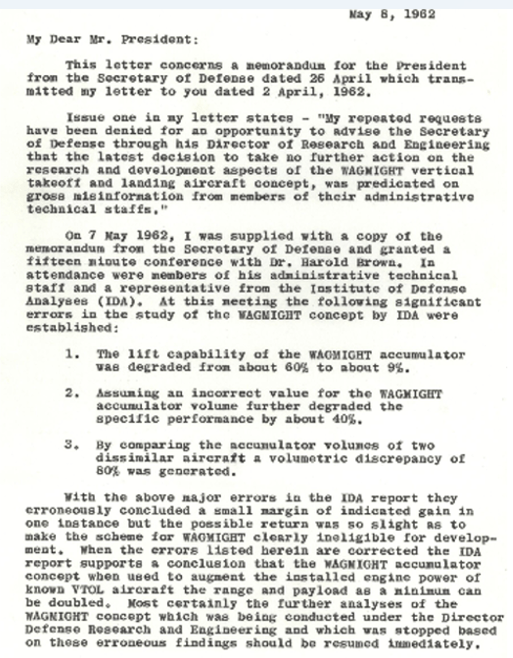
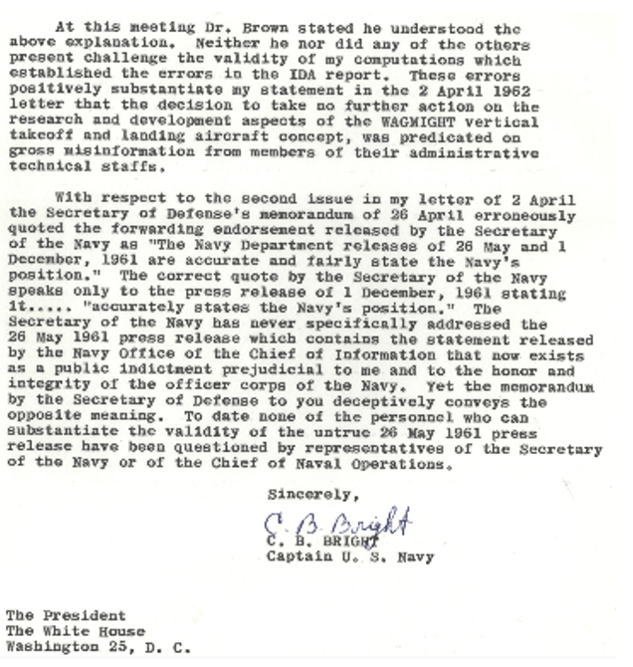
Captain Bright’s Letter to President John F. Kennedy re: WARMIGHT VTOL INFLATED PLANE (dated 8 May 1963); Shepard, Tazewell: “Wagmight” proposal, May 1962-November 1963, JFK Library, Columbia Point on Boston Harbor, Boston, Massachusetts, 17 Oct 1973
***
WHAT HAPPENED TO WAGMIGHT?
House Investigation of Navy Missile Coverup
Huntsville Times, Huntsville, Alabama
25 May 1961, p. 9
By ROBERT E. HOYT Chicago Daily News Service
WASHINGTON – Congress is looking into charges that the Navy’s Carrier Admirals torpedoed a revolutionary low-cost collapsible missile in a bitter intra-Navy fight.
Informed Navy sources say that Sec. John B. Connally is under instructions to hold up on any “binding policy decision” on the so-called Wagmight II project until the House Armed Services Committee can investigate.
This committee has been told that Capt. Cooper Bright, Wagmight project officer, was:
1. – Asked to perjure himself a year ago before a house appropriations subcommittee to make his testimony conform to official Navy position.
2. – Officially silenced by the Navy last November to keep him from discussing the project with Congress or the press, and especially to keep secret the fact that a (VTOL) (vertical takeoff and landing) system had been devised for Wagmight.
3. – Ordered to recall and destroy all booklets describing the VTOL Wagmight- booklets sent to manufacturers originally asked to submit development proposals.
A number of congressmen and senators, cutting through half a dozen different committees, have been kept quietly abreast of developments by Bright’s friends in the Navy.
***
Rep. Carl Vinson, D-Ga. chairman of the armed a services committee, sent a letter to Sec. Connally informing him of his interest in the Wagmight project, and requesting a personal report before a final decision is made.
The legislators have been told the opposition to Wagmight stems from the battle between “carrier admirals” and the rest of the fleet. The wide-scale use of Wagmight, according to reliable estimates, would make the big carriers virtually obsolete, as even small ships and submarines could carry, these folded-up, nuclear-armed missiles.
Wagmight II is a refinement of the original concept for a collapsible plane. It could be designed as a manned aircraft or a missile.
The advantages, as outlined by Capt. Bright before a congressional committee, a year-ago, are:
-Dozens of the units could be stored on existing ships and subs. It will fold into a 23-foot long cylinder, 50 inches in diameter.
-Because it is made of a rubberized fabric, it is virtually immune to radar detection.
-Wagmight would be powered by existing long-range, high speed jet engines, requiring no additional or development.
-Wagmight is cheap and highly mobile, could be used as a seaplane, from ships or trucks, could fit tactical or strategic needs.
-The entire project could be thoroughly researched for both missile and aircraft use for $4 million or $5 million.
The fight over Wagmight broke into the open a year ago when Vice Adm. John T. Hayward and Capt. Bright gave contradictory testimony before a House Appropriations Subcommittee.
This was before the VTOL development, however.
***
Adm. Hayward’s view the Navy had no technical requirement for Wagmight prevailed, but the admiral promised to keep the committee informed of any developments. He did not, however, report the VTOL plans.
Adm. Hayward has been hot and cold on the Wagmight project over the last couple of years. Congress has been told that the admiral ordered Bright to go ahead with the VTOL plans last summer, abruptly turned around and told he to destroy them–last November.
Capt. Bright first was ordered to talk to no one, at any time, about Wagmight.
Shortly after the Kennedy administration came in, the order was modified slightly – he could not discuss Wagmight during his working hours. He says, now, however, that he does not feel to discuss the matter even “after hours” because he was unable to get clarification of the order.
‘’I asked how much I could say,” and I was told to ‘be “discrete’.”
Bright was naval aide to President Truman when Truman was in Wahington for the inaugural of President Kenedy. Arrangements had been made before Navy brass heard what had happened. The captain got specific orders not to talk to Truman about the Wagmight fight.
CAPTAIN COOPER “COOP” B. BRIGHT, U.S.N., INVENTOR OF WAGMIGHT INFLATED VTOL AIRPLANE: BIOGRAPHY
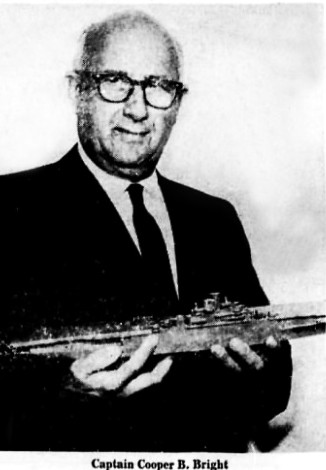
Captain Bright holds a model of his beloved aircraft carrier, U.S.S. Yorktown.
Caption to photo: CAPT Cooper B. Bright (USN – ret.), a 1931 Rutgers graduate, has returned to the university to do graduate work in political science. His 20 years of active service included a tour in Washington with the Chief of Naval Operations and 34 months in the Pacific aboard the USS Yorktown, a model of which he holds.
NAVY MAN RETURNS TO RUTGERS, Retirement Spawns New Career, Asbury Park Press, Asbury Park, New Jersey, 21 Nov 1963, p. 4
***
Captain Cooper Buck Bright, U.S.N. (1909-2007) was born in Wildwood, N.J., on Jan. 31, 1909, one of six siblings including a twin brother, Ward. He was the son of a prominent New Jersey family. His father, William H. Bright, was Cape May County state senator in the 1920s and served as president of the upper house. His mother, Priscilla F. Buck Bright, ran the family real estate business and was a women’s suffrage activist.
Mr. Bright with his brother, Ward, attended Staunton Military Academy in Staunton, Va., beginning in 1921. They graduated in 1927 as certified second lieutenants in the U.S. Army Infantry Reserve. He graduated with a bachelor of arts from Rutgers University in 1931.
During the Depression, he lived in Wildwood and Wildwood Crest, working in the family real estate business, built and operated a yacht marina, served as a sales manager for Curtis Publishing Co., and operated a fishing party boat during the summers.
His penchant for seeking creative solutions to problems resulted in his invention and patenting of an internal combustion, free piston engine, which was later sold to the American Machine and Foundry Corp.
Mr. Bright joined the Navy immediately after the attack on Pearl Harbor. Four of his siblings also enlisted in the armed forces at that time. Mr. Bright spent the war years aboard the USS Yorktown (CV10), known as the “Fighting Lady.” He was awarded 11 battle stars and the Bronze Star during that time. His leadership role in air operations aboard the Yorktown has been immortalized in a film entitled “The Fighting Lady.” Also, three books were written about his role -“Fighting Lad” and “On the Warpath in the Pacific,” both by Clark G. Reynolds; and “Carrier War” by Joseph Bryan. Mr. Bright’s achievements are part of the history told to visitors to the USS Yorktown, which is now part of the floating museum at Patriots Point near Charleston, S.C.
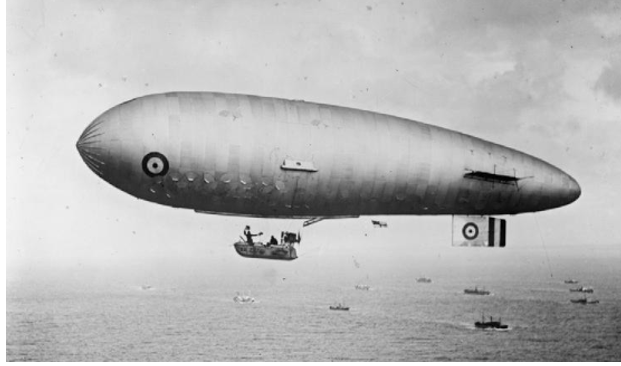
Mr. Bright made the Navy his career after the war, and worked at the Office of Naval Research and its predecessor, the Office of Special Devices. He was involved in the development of low-frequency air search radar and directed its deployment on Navy lighter-than-air blimps.
He also served as executive officer aboard the USS Winston, and became part of a United Nations peacekeeping mission to the Middle East headed by Dr. Ralph Bunche. In 1950 he became the last free balloon officer pilot to be trained by the Navy at Lakehurst, N.J., qualifying him to wear the half wing and be recognized as an aviator.
Other career highlights include being commanding officer of the USS White Marsh (LSD8), an amphibious landing ship dock, and commanding the USS Wrangell (AE12), an ammunition ship operating out of Earle, N.J. He served on the Joint Chiefs of Staff and with the Office of the Chief of Naval Operations, where he instituted operations research techniques in war gaming. He was a charter member of the Operations Research Society of America.
His favorite assignment was in 1961 when he served as naval aide to former President Harry S. Truman during the Kennedy inauguration. Another of his naval career high points was being sworn in as a captain by his sister, Capt. Joy Bright Hancock Ofstie. She was a founding member and later director of the WAVES.
Mr. Bright is also recognized as an aviation innovator by the Ohio Aviation Museum in Columbus as one of the inventors of the U.S. Navy inflatable airplane and for using Navy blimps to carry the large low-frequency antennae for anti-submarine warfare.
After his retirement from the Navy in 1963, he again attended Rutgers University on the G.I. Bill and studied for his Ph.D. in political science. He subsequently served as head of the Center for Transportation Studies at Rutgers’ Eagleton Institute of Practical Politics.
He retired to his 110-acre farm “Drop Anchor” in Cambridge, Maryland by the Eastern Shore of Chesapeake Bay and assumed the role of gentleman farmer. There he spent his days with his wife, Mary Williams Bright, restoring an old farmhouse and enjoying life. He also served on the County Soil Conservation District Committee and was president of the Dorchester Democratic Club.
Published by Bay To Bay News, Dover, Delaware, on May 5, 2007.
***
BKM, 01 Jul 2026