
The America Flag with Thirteen Stars (one star for each state in the Union,) and the Declaration of Independence that proclaimed the creation of the United States of America. AI Image Enhanced
By Bruce McWhirk, July 4, 2024
America first celebrated the Fourth of July in Philadelphia in 1777. It was the one-year anniversary of Independence Day, when the Continental Congress signed the Declaration of Independence. The glorious events in that city surrounding the celebration of the nation’s first birthday created a precedent and tradition which continues to the present-day throughout the nation.
On July 5, 1777, the Philadelphia Evening Post carried the following story describing the Independence Day festivities:
“P H I L A D E L P H I A
“Yesterday, the 4th of July, being the Anniversary of the Independence of the United States of America, was celebrated in this city with demonstrations of joy and festivity. About noon all the armed ships and gallies in the river were drawn up before the city, dressed in the gayest manner, with the colours of the United States and firearms displayed. At one o’clock, the yards being property manned, they began the celebration of the day by a discharge of thirteen cannon from each of the ships, and one from each of the thirteen gallies in honor of the Thirteen United States.
“In the afternoon an elegant dinner was prepared for Congress, to which were invited the President and Supreme Executive Council and Speaker of the Assembly of this state, the General Officers and Colonels of the army, and strangers of eminence, and the Members of the several Continental Boards in town.

General Von Knyphausen’s Hessian band was captured by General George Washington and the Continental Army at The Battle of Trenton on the 26th of December 1776 and it played celebratory music in Philadelphia to honor the first birthday of the United States of America. (illustration: Hesse-Kassel Abbildung derer uniformen von dem hochfürstl. Hess. Casselischen Militär – 52 Plates (possibly 1780s). AI Image Enhanced.
***
“The Hessian band of music, taken in Trenton the 26th of December last, attended and heightened the festivity with some fine performances suited to the joyous occasion, while a corps of British deserters taken into the service of the Continent by the State of Georgia, being drawn up before the door filled up the intervals with feux de joie [French: fires of joy]. After dinner a number of toasts were drank, all breathing independence, and a generous love of liberty, and commemorating the memories of those brave and worthy patriots who gallantly exposed their lives, and fell gloriously in defence of freedom and the righteous cause of their country.
“Each toast was followed by a discharge of artillery and small arms, and a suitable piece of music by the Hessian band.
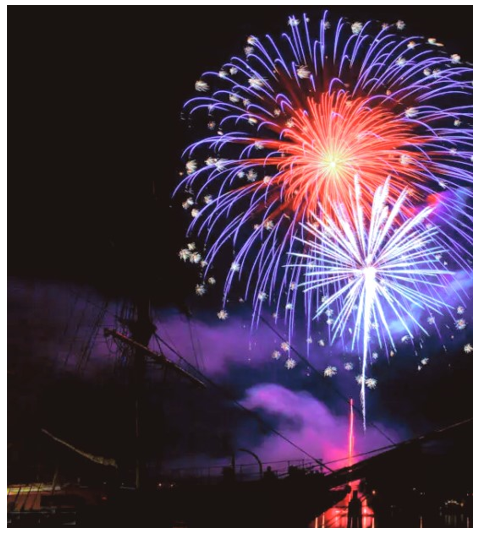
Fireworks over a Sailing Ship. (photo: Shunyu Fan) AI Image Enhanced
***
“The glorious fourth of July was reiterated three times, accompanied with triple discharges of cannon and small arms, and loud huzzas that resounded from street to street through the city.
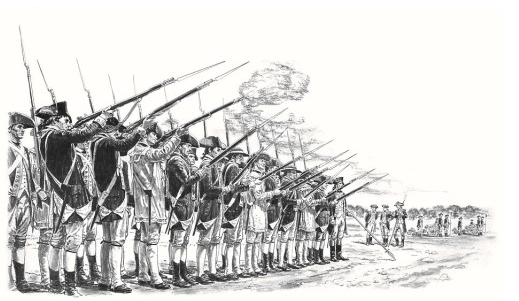
Continental and state troops perform a feu de joie (“fire of joy.”) Cannon smoke rises in the background, and a roar of muskets fire across the Grand Parade, as they celebrate the first anniversary of The Declaration of Independence. (artist: Ed Vebell, drawing: National Park Service). AI Image Enhanced
***
“Towards evening several troops of horse, a corps of artillery, and a brigade of North-Carolina forces, which was in town on its way to join the grand army, were drawn on Second-street, and reviewed by Congress and the General Officers.

“This eyewitness sketch shows Continental Army’s North Carolina Brigade, its soldiers and camp followers, marching through Philadelphia on Aug. 25, 1777, on their way to join General George Washington’s main force south of Philadelphia. Pierre Eugène du Simitière (1737-1784), a Swiss artist and collector who resided in Philadelphia during the Revolutionary War, inscribed on this drawing: “an exact representation of a waggon belonging to the north carolina brigade of continental troops which passed thro Philadelphia… Du Simitière also created from-life profile portraits of prominent Revolutionary leaders including Washington and he suggested the motto ‘E Pluribus Unum’ through his rejected design for the Great Seal of the United States in 1776.”; Caption and drawing, ink on paper: Museum of the American Revolution. AI Image Enhanced
***
“The evening was closed with the ringing of bells, and at night there was a grand exhibition of fireworks, (which began and concluded with thirteen rockets) on the Commons, and the city was beautifully illuminated. Everything was conducted with the greatest order and decorum, and the face of joy and gladness was universal.
“Thus may the fourth of July, that glorious and ever memorable day, be celebrated through America, by the sons of freedom, from age to age till time shall be no more. Amen, and amen.”
The Fourth of July celebrated in Philadelphia, Philadelphia Evening Post, 05 Jul 1777, p. 3
 NauticaSpace Press